
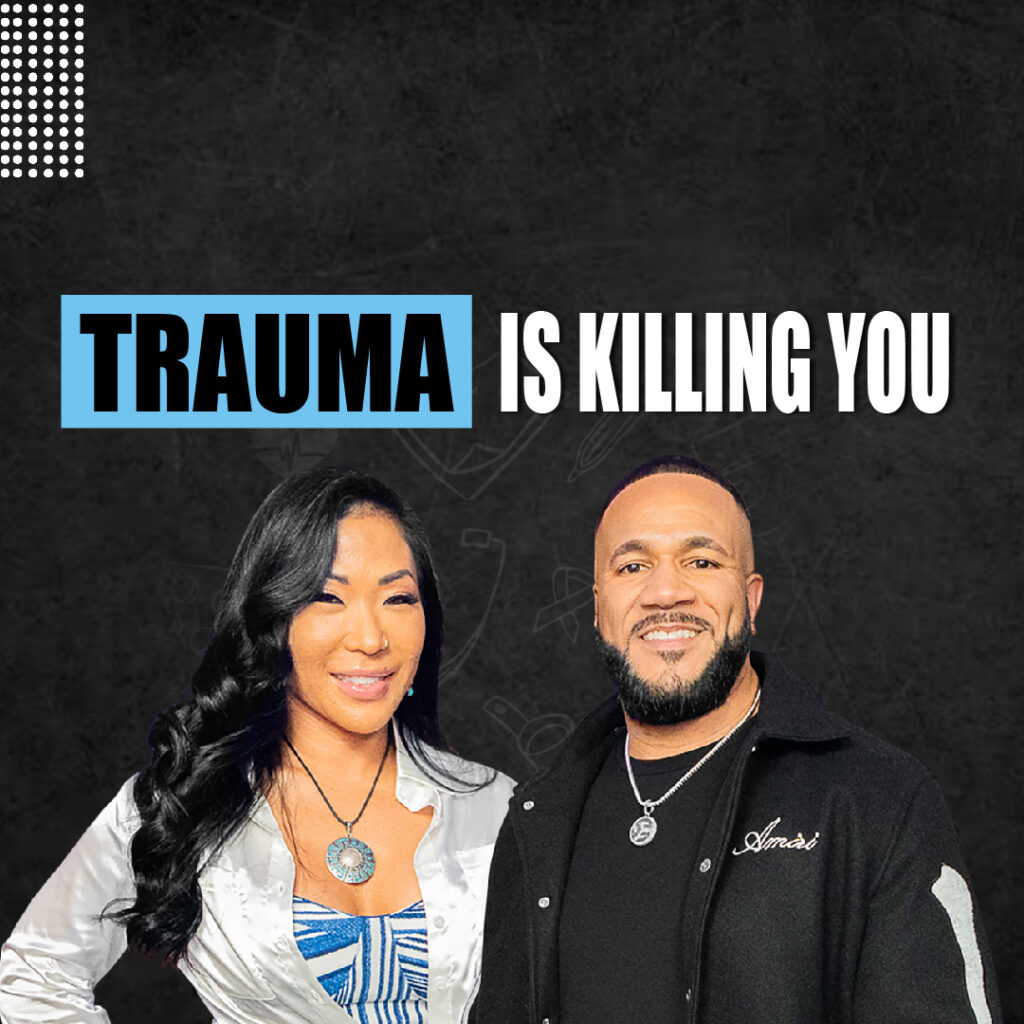
Trauma doesn’t always announce itself loudly. Sometimes, it hides in the nervous system, settles into the body, and quietly shapes how we think, feel, and react, often without us realizing it. On “A Healthy Point of View” podcast, Sam Tejada, CEO and Founder of Liquivida® sits down with transformational leader and trauma-informed coach Elisabeth Carson, a powerful voice in personal transformation and the founder of Enhance Flow, a company dedicated to global healing and conscious leadership, to explore how unresolved trauma impacts health, behavior, and chronic illness and how true healing begins from within.
Elisabeth’s story is not theoretical. It is lived, embodied, and deeply personal. From adoption trauma and addiction to incarceration, motherhood, and profound inner transformation, her journey offers a powerful lens into the mind-body connection and the possibilities of accessible healing.
Your Trauma Is Making You Sick — Here’s How to Fix It! Elisabeth Carson | Ep. 116
A Life That Began in Trauma
Elisabeth was born in Korea and adopted at just three months old, growing up in Michigan without ever knowing her biological mother. Through regression and somatic work later in life, she came to understand that her trauma didn’t begin in childhood; it began at birth.
She describes re-experiencing her entry into the world as one marked by emotional distress, separation, and fear. Her nervous system imprinted that experience deeply, shaping how she perceived safety, abandonment, and connection throughout her life.
That early wound followed her into adolescence. By the age of 11 or 12, Elisabeth had begun experimenting with substances. At 14, she moved out of her parents’ home and into an environment with little supervision, quickly becoming immersed in drugs, partying, and survival-based decision-making. What looked like rebellion on the outside was, internally, a nervous system trying to cope.
When Survival Becomes the Norm
At 15, Elisabeth was taken from her home in the middle of the night and placed into a wilderness bootcamp program, a moment she describes as profoundly traumatic. Although the experience taught her resilience and survival skills, it reinforced a pattern she already knew well: instability, loss of control, and emotional rupture.
Her late teens and early twenties were marked by addiction, hustling, and dissociation. While working as an exotic dancer in Detroit, substance use escalated. A prolonged period of heavy drug use eventually left her cognitively impaired, unable to finish sentences, and disconnected from her sense of self.
It was during this low point that Elisabeth was introduced to neurofeedback, a turning point that would alter the trajectory of her life.
The First Breakthrough: Neurofeedback and Mental Clarity
After five consecutive days of intensive neurofeedback training, Elisabeth experienced something she hadn’t felt in years: clarity. Her thoughts organized. Her nervous system settled. Her ability to function returned.
For the first time, she felt what it was like to live outside of constant fight-or-flight.
That contrast was life-changing. It showed her that the chaos she had normalized wasn’t her baseline; it was trauma.
Although she would temporarily return to old patterns, the seed had been planted. Elisabeth now knew that healing was possible.
Trauma Defined: It’s Not What Happened, It’s What Stayed
Elisabeth challenges the traditional idea that trauma must be extreme to be valid. In her view, trauma is not defined by the event itself, but by how the nervous system internalizes and responds to it.
There is no hierarchy of trauma. A moment that overwhelms one person’s system may not affect another’s, but the body always remembers.
She explains how early childhood experiences, especially from the womb through age seven, shape subconscious programming. During these formative years, brainwaves operate in delta and theta states, meaning experiences are absorbed directly into the subconscious, forming the blueprint for future behavior, emotional regulation, and stress responses.
When trauma occurs repeatedly during this stage, the nervous system can become locked in hypervigilance, constantly scanning for threats, even when none are present.
From Trauma to Chronic Illness
One of the most powerful insights Elisabeth shares is the connection between unresolved trauma and chronic disease. When the body remains stuck in fight-or-flight, stress hormones like cortisol and adrenaline flood the system continuously.
Over time, this leads to inflammation, the foundation of many chronic and autoimmune conditions.
Trauma doesn’t just live in the mind. It lodges in muscles, organs, posture, and breath. Elisabeth noticed that she habitually clenched her hip without realizing it; a physical manifestation of stored stress. Restricted blood flow, tension, and inflammation followed.
Healing, she believes, must address both the emotional root and the physical expression.
The Moment Everything Changed
While incarcerated and later on the run with her partner, Elisabeth became pregnant. Motherhood forced a reckoning she could no longer avoid.
The defining moment came when she walked into a prison carrying her three-month-old son and watched his father be taken away in handcuffs. In that instant, she saw her life clearly and understood that the emptiness she felt internally had created the chaos externally.
This was the moment she fully committed to healing.
She immersed herself in studying trauma, biohacking, nervous system regulation, and consciousness, not to optimize performance, but to survive, to heal, and eventually to help others do the same.
Healing Is Not a Luxury, It’s a Right
One of Elisabeth’s strongest critiques of the wellness and biohacking space is its lack of accessibility. Too often, advanced tools are reserved for the wealthy, while those who need healing most are priced out.
In response, she began advocating for accessible healing practices, methods that anyone can use, regardless of income.
Some of the most powerful include:
- Grounding (bare feet or hands on the earth to reduce inflammation)
- Walking meditation for those who find seated meditation overwhelming
- Emotional Freedom Technique (EFT) tapping
- Trauma Release Exercises (TRE) to discharge stored stress
- Self-soothing and reparenting practices
- Journaling and nervous system awareness
These tools regulate the body, create safety, and expand awareness, the first and most crucial step in healing.
Awareness Comes Before Transformation
Elisabeth emphasizes that healing always begins with awareness. Without it, change is impossible.
Trauma recovery is not about forcing positivity or bypassing pain. It’s about creating enough internal safety to look honestly at what shaped you and gently unraveling it.
Even something as simple as spending time in nature, regulating sleep, or avoiding overstimulation first thing in the morning can profoundly shift the nervous system.
True biohacking, she explains, starts with knowing what to say no to.
Healing the Future by Healing the Past
From inner-city environmental toxicity to generational trauma, Elisabeth reminds us that health is never isolated. It is shaped by environment, policy, culture, and early life experiences.
When we fail to address trauma, individually or collectively, we see the consequences in chronic illness, addiction, mental health struggles, and societal breakdown.
But when we prioritize nervous system regulation, emotional safety, and accessible healing, the ripple effects are transformative.
A New Definition of Wellness
Elisabeth Carson’s journey reframes wellness not as perfection, but as presence. Not as expensive optimization, but as reconnection. Not as avoidance of pain, but as conscious integration.
Healing doesn’t require becoming someone new. It requires returning to who you were before survival took over.
And that, as this conversation powerfully shows, is possible for anyone.