

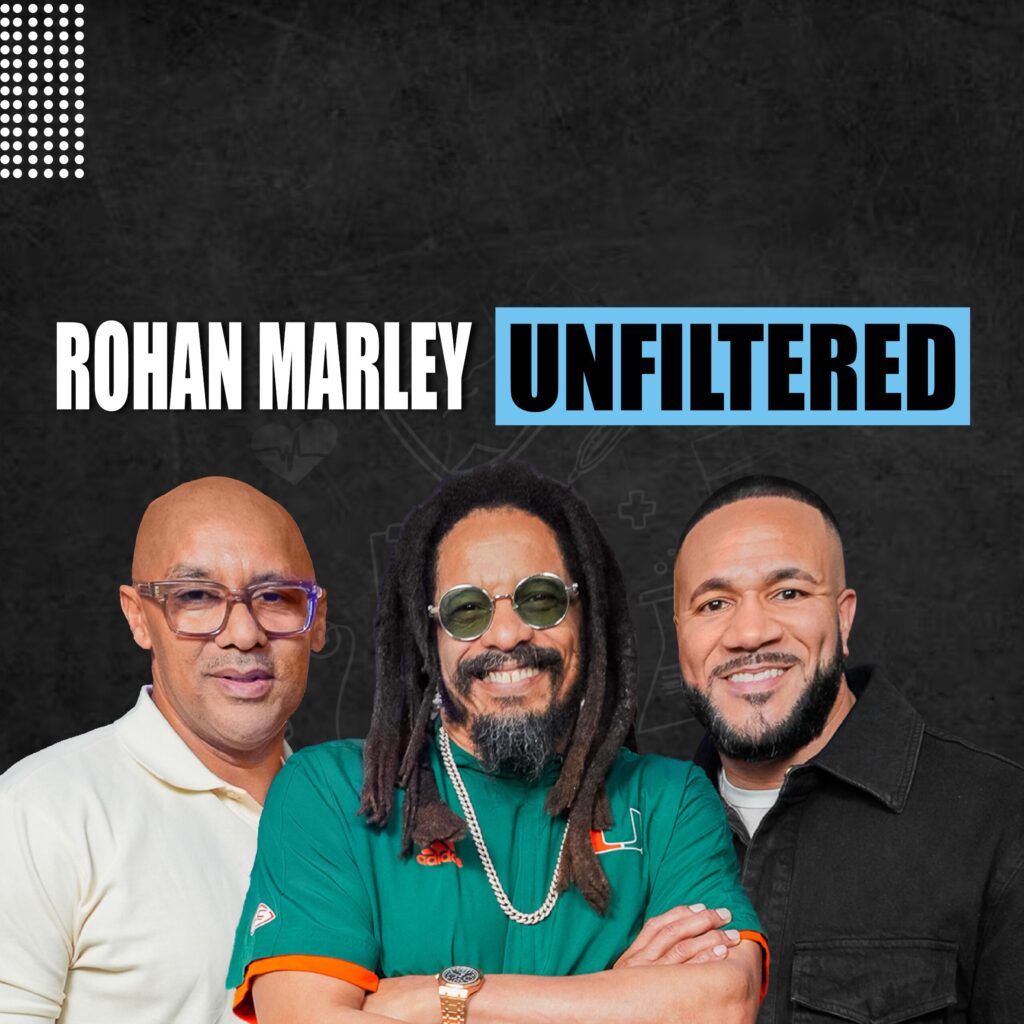
In an episode of “A Healthy Point of View” podcast, Sam Tejada, CEO and Founder of Liquivida®, sits down with entrepreneur, former University of Miami football player, and Bob Marley’s son, Rohan Marley, alongside co-host Corey Jacobs.
At first, the conversation moves like many others around health and performance. There’s talk of discipline, lifestyle, and the habits that shape how we feel day to day. But it doesn’t stay on the surface for long.
Because for Rohan, this isn’t about trends or theories. It’s about a moment that forced him to stop and take a hard look at himself.
Rohan Marley Reveals The Truth About Health, Legacy, And Rastafari | Ft. Corey Jacobs | Ep. 128
“I Thought I Was Doing Everything Right”
For most of his life, Rohan has lived with intention. He’s been active, mindful of what he eats, and committed to a certain level of discipline. From the outside, and even to himself, that should have been enough.
So when he went in for a deeper health evaluation, it wasn’t out of concern. It was routine. Almost curiosity more than anything else. What came back wasn’t what he expected.
Despite everything, he believed he was doing right, but the data told a different story. Internally, things weren’t as balanced as they appeared. The biggest surprise was visceral fat, something you can’t see, something that doesn’t show up in the mirror, but carries real consequences.
That moment stayed with him.
Not because it scared him, but because it challenged something more subtle: the assumption that effort always equals results.
The Danger of Assuming You’re “Fine”
There’s a quiet honesty in the way Rohan talks about it. No exaggeration, no drama, just a clear realization.
Most people don’t actually know what’s going on inside their bodies. They rely on how they feel, how they look, or what they’ve always believed about themselves. And if nothing feels wrong, they don’t question it.
That’s where the gap is.
Because feeling “fine” isn’t the same as being healthy. And looking fit doesn’t always mean your body is functioning the way it should.
For Rohan, getting real numbers changed everything. It replaced assumption with clarity. It gave him something real to respond to, instead of something to guess about.
A Different Way to Look at Health
What stood out in his experience wasn’t just the results; it was the approach.
He talks about how different it felt compared to the usual pattern people are used to. The typical cycle is simple: something feels off, you go to a doctor, and you leave with a prescription.
This wasn’t that.
This required participation. Awareness. Responsibility.
It wasn’t about fixing a symptom and moving on. It was about understanding what was happening beneath the surface and being willing to adjust your lifestyle because of it.
That shift sounds simple, but it’s not easy. Because it asks more from you.
“Lion Order” and Knowing Who You Are
Rohan introduces the idea of “Lion Order.” Not as a system or a method but as a mindset.
He describes it in a way that feels almost instinctive. A lion doesn’t spend time proving itself. It doesn’t react to everything around it. It doesn’t seek validation.
It simply exists in its nature.
For him, that’s the lesson. To be grounded in who you are without constantly looking outward. To move with clarity instead of reaction. To stop measuring yourself against everything around you.
It sounds straightforward, but living that way requires a level of self-awareness most people don’t slow down enough to develop.
Rethinking What It Means to Get Older
There’s also a shift in how Rohan speaks about age.
In his 50s, he doesn’t describe life as something that’s winding down. If anything, he talks about it with more intention than before.
There’s a sense that the first half of life is about movement, trying things, building, and learning. But the second half is about awareness. About being more deliberate with your choices.
It’s not about decline. It’s about clarity.
And that perspective changes how you approach everything, from health to purpose to the way you spend your time.
A Name Isn’t Enough
Being the son of Bob Marley is something the world notices immediately. But it’s not something Rohan leans on.
He speaks about legacy in a way that feels grounded. A name might open a door, but it doesn’t build anything for you.
That’s something he carries into how he’s raised his children as well. The understanding that identity isn’t something you inherit, it’s something you create through your actions.
You still have to show up. You still have to do the work.
Building Something That Feels True
After football, his path didn’t follow a straight line.
There wasn’t a clear next step or a predictable direction. Instead, he found himself in Jamaica, working with coffee farms, something that, at the time, probably didn’t look like a calculated business move.
But over time, it became something more.
Not just a business, but something aligned with how he wanted to live. Natural. Intentional. Without shortcuts.
That part of his story doesn’t feel rushed or forced. It feels like something that unfolded slowly, the way most meaningful things do.
It’s easy to move through life assuming everything is fine physically, mentally, and emotionally without ever really checking.
And at some point, that catches up with you.
Not always in a dramatic way. Sometimes, just in small realizations that something isn’t as aligned as you thought.
Rohan’s experience doesn’t come across as a warning. It feels more like a reminder.
To pause. To look a little deeper. To stop relying on assumptions.
Because no one else is going to do that part for you.
And sometimes, just being honest with yourself is where everything starts to change.